Free Diwali printables made from your own words
Diwali is a time for sending good wishes, so cards matter. Many free printables give you one design with a blank space. Here, you type each person's name and your own message, and every card comes out personal. No need to write the same line twenty times.
It is free, runs in your browser and needs no account. Choose A4 or US Letter, then print or save as a PDF. The pages are plain line art, which also suits the ink saver option.
A short word about Diwali
Diwali, also called Deepavali, is the festival of lights. It is celebrated by many Hindu, Sikh and Jain families, and by some Buddhists, in India and around the world. Homes are cleaned and decorated, small oil lamps called diyas are lit, families share sweets and visit one another, and many people wear new clothes.
Customs differ between regions and families, so use what fits your own home. In 2026 the main day of Diwali is Sunday 8 November, according to timeanddate.com. The festival is tied to the lunar calendar, so the date changes from year to year.
What is in the Diwali set
The set has three parts.
- Greeting cards: two to a page, folded in half. The front says Happy Diwali with a lamp. Inside is "Dear" and the recipient's name, your message and "With love" followed by your family name. You can add up to 24 names.
- A Diwali planner page: four checklists for home, sweets and food, gifts and cards, and visits and calls, a gift list and a space for sweets to make or buy.
- A rangoli page: a symmetrical pattern for colouring, generated from your family name and the number of folds you choose.
Diwali greeting cards you fold in half
Each page holds two cards. Cut along the middle line, then fold each half over so the lamp is on the front and the message is inside. If you leave the names empty, you get cards with a blank line after "Dear", so you can write each name by hand.
The default message reads "Wishing you a Diwali full of light, sweets and time together." Change it to anything you like, in any language your keyboard supports. A line in your own words is warmer than a stock greeting.
- Type your family name, so the cards end with "With love" and your name.
- Write your message, or keep the suggested one.
- Add one recipient per line, for as many cards as you need.
- Print, cut along the middle line and fold each card in half.
- Sign the inside by hand before you hand it over or post it.
A festival preparation planner
Diwali week is full: cleaning, shopping, cooking, visiting. The planner puts it in one place, so the jobs do not sit in your head. It has four groups, each with tick boxes and a few blank lines of your own.
The groups are a general starting point and every family does things its own way. Cross out what you do not need and add what you do.
- Home: clean and declutter, put up lights and lanterns, arrange diyas, plan the rangoli design.
- Sweets and food: choose sweets to make or buy, plan the festive meal, buy dry fruits for guests.
- Gifts and cards: make the gift list, print and sign greeting cards, wrap gifts.
- Visits and calls: plan family visits, call relatives far away, invite neighbours.
A rangoli to colour, made from your family name
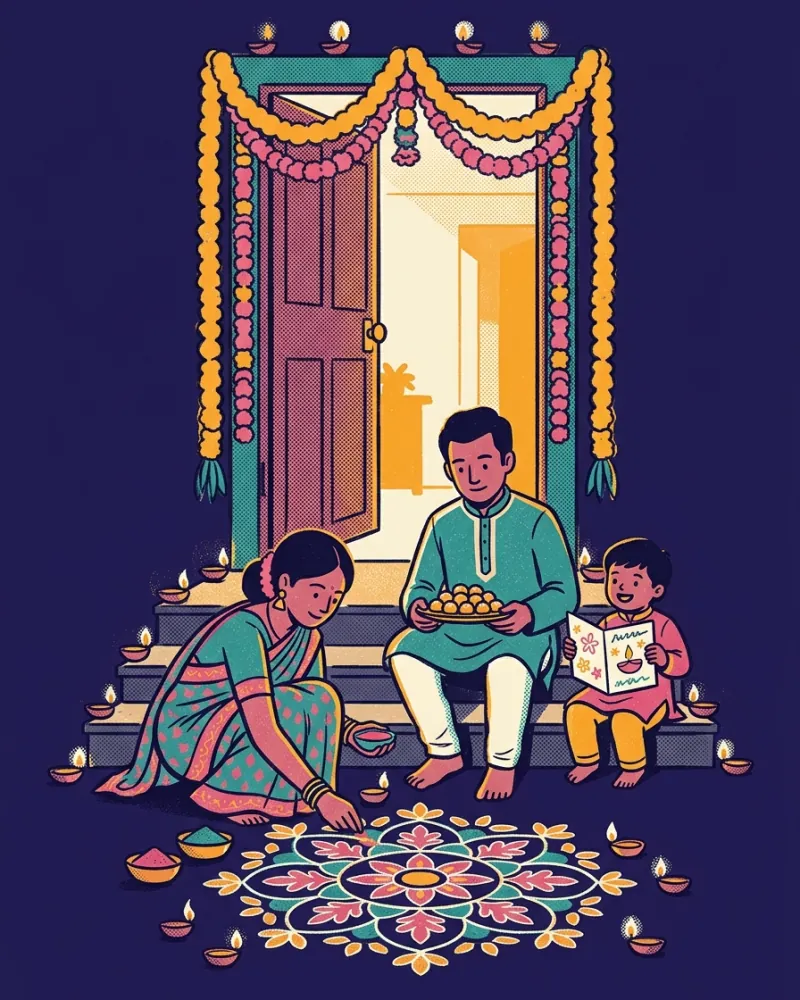
Rangoli is the colourful pattern many families make at the entrance of the home during Diwali, often with coloured powder, rice flour or flower petals. It is usually symmetrical and often built from circles, petals and lamps.
The rangoli page here is a line drawing for colouring in with pencils, felt tips or crayons. The pattern is generated from the family name and the number of folds, meaning how many times the design repeats around the circle, anywhere from 6 to 16. The same name and folds always give the same design, and a new name gives a new one.
It is a drawing to colour on paper, not a guide to making a traditional rangoli. If you want to make one on the floor, you can use the printout as a plan for the shapes and colours you want to try.
Printing tips and privacy
Choose A4 or US Letter before you print. Card stock makes sturdier greeting cards, but plain paper folds well enough. The ink saver option suits the rangoli page well, since it is already line art.
Names and messages stay in the link after the # in your browser. They are never sent to a server, so your family and friends' names stay with you.
Questions people ask
Are these Diwali printables free?
Yes. They are free, need no account and work in your browser. Print or save as a PDF as often as you like.
What is the date of Diwali in 2026?
The main day is Sunday 8 November 2026, according to timeanddate.com. Diwali follows the lunar calendar, so the date moves each year.
How do the greeting cards work?
Two cards fit on a page. Cut along the middle line and fold each in half. The front says Happy Diwali, and inside is the recipient's name, your message and your family name.
Can I write my own message?
Yes. The set suggests a short message, but you can replace it with your own words. Add up to 24 recipients, one per line.
What is a rangoli?
Rangoli is a decorative pattern made at the entrance of the home during Diwali, often with coloured powder, rice flour or petals. The one here is a drawing to colour in on paper.
How is the rangoli pattern made?
It is generated from your family name and the number of folds, from 6 to 16. The same inputs always give the same pattern, and changing the name gives a new one.
Can I print on US Letter or A4?
Both. Pick your paper size before printing. The ink saver option gives lighter pages.
Is what I type kept private?
Yes. Names and messages stay in the link after the # in your browser and are never sent to a server.